Seventy-Three Winters

Talk to my grandma and you will hear stories about me in diapers taking my first steps in mixed race America. I’m a mixed-blood, Cherokee, Lenape, Seneca and part white with German and Jewish ancestry. The daughter of teenage parents and the granddaughter of sharecroppers. My dad’s side of the family came to California in 1936 after The Great Dust Bowl in Oklahoma when they could no longer sharecrop.
First marker moment. It’s 1956 and I am three years old. I’m in the backseat. My dad is driving and my mother is beside him, screaming. Some guys are pulling my dad out of the car, beating him. Mexican guys come to help my dad. We are safe now.
I will replay this memory over and again. A decade later I will understand. Because he was a brown boy, a half breed, with a white girl.
The story I tell myself is the white guys had chains. But maybe the Mexican guys who helped us had the chains. Why do I remember chains?
1956 was also the year that saw explosive clashes all across the South, between African Americans, who were determined to overthrow Jim Crow, and hardline white supremacists pledged to ‘massive resistance.’ In Montgomery, African Americans persisted with their boycott of the city’s segregated buses in the face of death threats, bombings, petty harassment, insults, economic coercion and mass arrests.
In 1956 we lived in Southeast Los Angeles, in the city of Paramount, bordering Compton, with two tiers, white and everyone who wasn’t white.
A few years later my dad will have “the talk” with me, about how to be street smart and safe. By then I had already figured it out. I’m in grade school now, attending the Compton City School District.
The pattern is set. By age ten I have learned that everyone who isn’t white feels safe to me. White feels like walking a razor’s edge. You had to watch yourself at all times. Be aware. Watch for clues. Make up stories to protect your mixed-race, under-educated family. If you don’t pass the tests issued by the mothers or the fathers they won’t allow you to play with their white daughter. Me, a rough-around-the-edges girl with skin so light, assumed to be white, as long as she answers the questions right.
But the mixed-race families and the brown skinned families would always take you in, without asking too many questions.
Second marker moment. It’s 1963 and a new family moves into the house across the street, German immigrants, with a kind boy, my age. Neighborhood gossip issued from the first tier said they belonged to Hitler’s Youth, long ago, moved to America to escape all of that. The taunting begins. Nazi signs are painted all over the house. Broken, the family moves away. I think about my German grandmother with Jewish ancestry and about the hate she endured during and after the war.
That same year Martin Luther King announced to the March on Washington during his famous “I have a dream” speech that “1963 is not an end, but a beginning.” For legal segregation, it would turn out to be the beginning of the end. The year started with Alabama governor George Wallace standing on the steps of the state capitol in hickory-striped trousers and a cutaway coat declaring: “Segregation now, segregation tomorrow, segregation forever.”
It’s 1965 and the sun is an orange haze and the sky turns black. The Watts Riots have begun. I’m twelve years old. The city of Watts is on the other side of Compton, not far away. Smoke is thick in the air and I worry about friends and everyone else in danger.
Later that same year I will learn that although women were guaranteed the right to vote in 1920 by the Nineteenth Amendment, in some southern states, African American women were unable to freely exercise their right to vote until 1965.
And the understanding lodges deep within me, of how white thinking is a mindset carefully taught, handed down, maneuvered, steered, controlled like over planted land and polluted waters, a way of moving through life that must be avoided.
It’s 1972 and I’m nineteen and pregnant. In a social welfare office, I list my ethnicity as American Indian. The father of the baby is also American Indian, but I will not reveal his name. Instead, I write down that the father is unknown.
The welfare officer, a white women, gives me a lecture, tells me I’m trash for sleeping with any Tom, Dick or Harry. I huddle in the hallway and cry. Another social worker, a black woman, comes to check on me and when I tell her what happened she hugs me and says that I’m not the first pregnant girl and lord knows I won’t be the last, and not to pay any mind to anyone who treats me like I’m less than.
Maybe the social worker who said I was trash was just a spiteful woman and it had nothing to do with racism. Yeah. Maybe.
1972 is also the year AIM organizers (American Indian Movement) and local Native parents, motivated by prejudice in the child welfare system and hostility in the public schools, started their own community school. The story of these survival schools, unfolding through the voices of activists, teachers, and families, is also a history of AIM’s founding and of its long-term effect on Indian people’s lives.
White privilege: the ability to attribute hateful behavior to isolated incidents, classism, back luck or just a bad social worker with a bad bedside manner.
2019. I’m a grandmother, walking toward elderhood and holding space for the pain of all those who hurt.
2026. I’m seventy-three and I stay open, year after year, of heartache, walking this good earth, with clear eyes, and ears. Because like the roots of the cedar, deep within I carry, we all carry, blood memory, in our DNA and the wisdom from our ancestors with the power to heal the next seven generations.
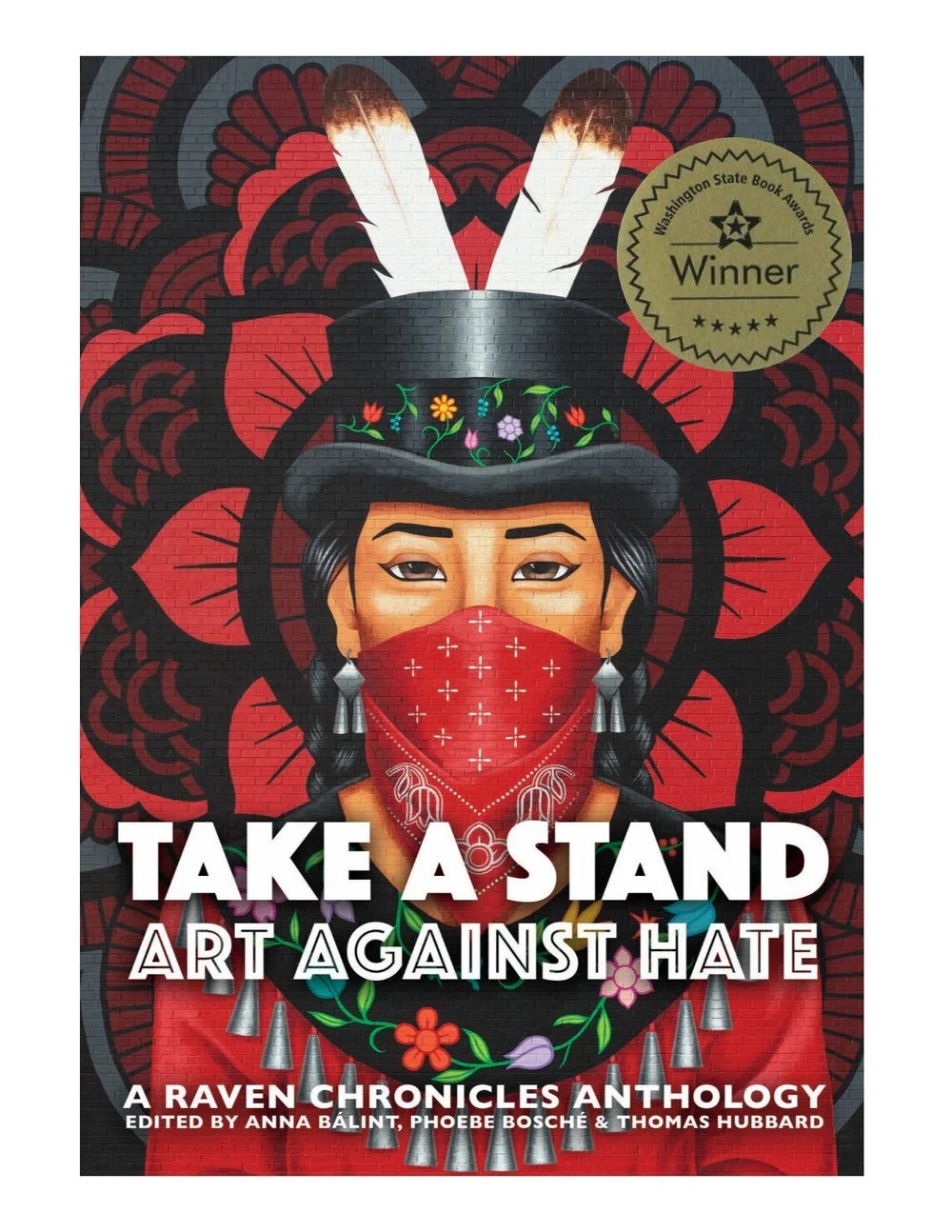
First published with the title Sixty Six Summers in Take A Stand: Art Against Hate (A Raven Chronicles Anthology).
Words Facing West by Terra Trevor
Telling stories steeped in themes of place and belonging, a mixed-blood identity, mixed roots, and a connection to the landscape.
Terra Trevor is the author of We Who Walk the Seven Ways: A Memoir (University of Nebraska Press), and Pushing up the Sky: A Mother’s Story (KAAN). Her essays appear widely in anthologies, including Tending the Fire: Native Voices and Portraits (University of New Mexico Press), Children of the Dragonfly: Native American Voices on Child Custody and Education (The University of Arizona Press), The People Who Stayed: Southeastern Indian Writing After Removal (University of Oklahoma Press), Unpapered: Writers Consider Native American Identity and Cultural Belonging (University of Nebraska Press), and Mixed Roots: Writers on Multiracial Identity & Both/And Belonging (Beacon Press).
This piece is really powerful, Terra.